

Why Grief Was the Real Villain of X-Men '97 Season 2
While Apocalypse and Mister Sinister provided the physical threats in X-Men '97 Season 2, emotional trauma drove every major narrative arc. From Polaris grappling with Magneto's death to Nightcrawler facing inherited hatred, grief served as the animated series' most powerful and pervasive through-line across all nine episodes.
Key Takeaways
- Grief replaced standard villain tropes as the primary thematic engine driving X-Men '97 Season 2's character arcs.
- Polaris stepped into the spotlight following Magneto's death, offering a fresh exploration of generational loss.
- Wolverine and Morph tackled dehumanization and friendship, adding emotional depth to the Weapon X narrative.
- Nightcrawler's courtroom sequence highlighted the heavy philosophical weight of inherited trauma versus personal redemption.
- Rogue and Gambit's tragic storyline capitalized on the lingering scars from the devastation of Genosha.
Grief as the Ultimate Through-Line
Television adaptations of classic comic book properties often rely on standard escalation formulas—bigger explosions, more powerful villains, and higher stakes. However, X-Men '97 Season 2 chose a more introspective path. By anchoring its narrative conflicts in profound personal loss, the writers elevated the emotional resonance of the series far beyond standard Saturday morning cartoon fare. Viewers watched characters navigate the debilitating aftermath of catastrophe, proving that internal wounds often require much longer to heal than physical ones.
This thematic choice allowed the series to breathe between massive action sequences. Instead of rushing from one battle to the next, the episodes deliberately paused to examine how different mutants process sorrow, anger, and abandonment. Whether dealing with the permanent absence of loved ones or the shattering of deeply held beliefs, the mutant roster felt profoundly human in their suffering.
Polaris and the Shadow of Magneto
The conclusion of the massive Apocalypse opening arc left a massive vacuum with the apparent death of Magneto. Rather than immediately pivoting to another cosmic threat, the series smartly introduced Polaris to the forefront. As Magneto's daughter, Polaris brought a uniquely complicated emotional baggage to the school.
Her storyline in Episode 6 allowed the creative team to explore grief through a lens distinct from Professor Xavier's familiar mourning. Polaris carried her own distinct set of grievances, balancing the legacy of a legendary father with the isolating reality of her own existence. This shift also revitalized the classic "school for the gifted" concept, grounding the superhero spectacle in relatable family dynamics and personal loss.
Wolverine, Morph, and the Weight of the Past
Even action-heavy diversions like Wolverine's Weapon X reunion leaned heavily into psychological trauma. As Wolverine sought to reclaim his adamantium and confront his black-ops history, the narrative examined the dehumanizing impacts of institutional experimentation.
Morph served as a vital emotional anchor during these sequences. Their steadfast support of Wolverine highlighted themes of unconditional friendship and loyalty. Rather than exploiting these interactions for superficial melodrama, the show used quiet moments between Wolverine and Morph to showcase how companionship acts as a vital shield against the lingering ghosts of past trauma.
Inherited Hatred and Philosophical Redemption
The midpoint of the season pushed characters like Nightcrawler and Graydon Creed into moral gray areas that tested the limits of forgiveness. In Episode 7, Nightcrawler found himself holding court over Creed, forcing a direct confrontation with generational malice.
Creed's defense—rooted in abandonment issues and mistreatment by human parents—transformed into a broader statement on how hatred passes down through families. Nightcrawler's eventual judgment was neither purely merciful nor coldly vindictive; it reflected a mature understanding of systemic pain. This philosophical depth is precisely why the X-Men mythos remains enduringly relevant to audiences searching for thoughtful genre storytelling.
Rogue, Gambit, and the Scar of Genosha
No storyline captured the devastating cost of grief quite like the tragic saga of Rogue and Gambit. The destruction of Genosha cast a long, oppressive shadow over the entire season, culminating in Gambit's resurrection as Apocalypse's Horseman of Death.
While some fans felt a dedicated Gambit flashback episode would have heightened individual stakes outside of his relationship with Rogue, the emotional weight remained unmistakable. Rogue's nightmares of an undead Gambit and her desperate willingness to sacrifice her own body inside the Celestial machinery proved that love and grief are inextricably linked in mutant lore. The ultimate cost—Nightcrawler sacrificing his life for his sister—cemented a season where victory always demanded a heartbreaking toll.
Conclusion
X-Men '97 Season 2 proved that superhero animation can tackle complex emotional themes without sacrificing action or fan service. By treating grief as a multi-layered monster that every character had to face, the series delivered some of its most compelling television to date. To hear our complete breakdown of these episodes and our live-action casting reactions, be sure to Listen to the full episode. Join us next time on Scene N Nerd as we continue unpacking the biggest moments in sci-fi and comic book culture!
Frequently Asked Questions
How does X-Men '97 Season 2 explore grief differently than previous seasons?
Instead of focusing solely on broad political commentary, Season 2 personalizes loss through distinct character lenses like Polaris, Wolverine, and Rogue, showing how different mutants process trauma.
Why is Polaris such an important addition to the Season 2 narrative?
As Magneto's daughter, Polaris steps into the leadership vacuum left by his apparent death, offering a fresh perspective on generational loss and family legacy.
What role does Morph play in Wolverine's storyline?
Morph acts as an essential emotional anchor and loyal friend, helping Wolverine process the dehumanizing psychological impacts of the Weapon X program.
How does the theme of inherited trauma manifest in the middle episodes?
Episodes featuring Nightcrawler and Graydon Creed explore how parental abuse and societal rejection breed generational hatred, forcing characters to choose between vengeance and understanding.
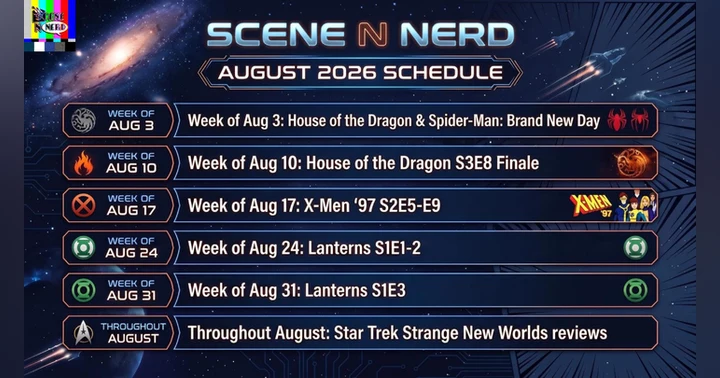
August 2026 at Scene N Nerd: Dragons, Lanterns, and the Final Frontier!


