

How House of the Dragon Season 3 Turned a Succession War Into a Holy War
House of the Dragon Season 3, Episode 8 expanded the Targaryen civil war far beyond a mere political dispute over the Iron Throne. By weaponizing divine right theology and religious zealotry, the conflict evolved into a brutal holy war that fundamentally alters the nature of power in Westeros and redefines Rhaenyra's leadership choices.
Key Takeaways
- House of the Dragon S3E8 marks the definitive shift from a political succession dispute to a religious holy war in Westeros.
- The Targaryen ideology of viewing themselves as higher gods shapes their ruthless political decisions and moral justifications.
- Rhaenyra's interactions with religious entities highlight the dangerous intersection of divine right and violent fanaticism.
- Characters like Helaena and the dragonseeds navigate a shifting landscape where secular loyalty is entirely replaced by zealous devotion.
- The practical siege warfare elements mirror classic fantasy struggles, emphasizing the devastating human cost of this holy crusade.
The Evolution From Succession Crisis to Holy War
When the Dance of the Dragons first began, it was ostensibly a straightforward constitutional and familial crisis: Who had the legitimate right to succeed Viserys I? Was it his chosen daughter Rhaenyra, or his eldest son Aegon, backed by the Hightower machinery? However, as the conflict has dragged on through the seasons, the ideological underpinnings have shifted dramatically. By the time we reach the events discussed on our podcast, the war is no longer just about taxation, armies, and dynastic alliances. It has morphed into a holy war.
This ideological escalation occurs because the participants are no longer just fighting for territory; they are fighting for the very soul of Westerosi belief systems. The introduction of religious entities that explicitly question or validate the divine right of kings turns every battlefield into a holy site. When spiritual fanaticism intersects with nuclear-level deterrents like dragons, the stakes are exponentially amplified. The common folk and regional lords are forced to pick sides not based on feudal obligations, but on cosmic righteousness.
The Dangerous Theology of Targaryen Exceptionalism
A central theme underpinning the escalation in House of the Dragon is the persistent Targaryen belief that they are essentially higher gods walking among mortals. This belief is not merely personal arrogance; it is a foundational political philosophy that dictates how they treat everyone else in the realm. When a ruler genuinely believes they are divine, the traditional moral constraints that apply to ordinary humans completely dissolve.
Rhaenyra's Theological and Moral Burden
As Rhaenyra grapples with the terrifying price of leadership, her actions reflect this heavy burden of perceived divinity. Her choices—including the increasingly harsh treatment of those around her—stem from a desperate need to maintain absolute authority in a world fracturing along religious lines. When she confronts religious entities who preach about higher powers, she is defending her own family's monopoly on the divine right to rule. If the gods belong to the realm, then the Targaryens lose their exclusive claim to sit above the laws of men.
The Tragic Intersection of Prophecy and Zealotry
The violent realities of this holy war hit closest to home in how vulnerable members of the royal family are exploited. Helaena's poignant sacrifices and the chilling dynamics within the Hightower family—such as Ormund's manipulations of Daeron—demonstrate how individual lives are treated as mere currency in a holy crusade. In a war defined by divine mandates, human empathy is the first casualty.
Practical Siege Warfare Meets Fanatical Devotion
Beyond the philosophical debates, the visceral reality of this holy war is put on full display during the siege sequences. The production choices lean heavily into practical effects and the gritty, medieval nature of siege warfare, evoking comparisons to classic high fantasy epics like The Lord of the Rings. This grounded aesthetic contrasts sharply with the cosmic, almost mythical scale of the Targaryen riders.
Characters on the ground, such as the low-key MVPs of the conflict and the unpredictable dragonseeds like Hugh and Ulf, are caught in the grinder of this ideological machine. Speculation about betrayals and shifting loyalties highlights the instability of an army bound by religious fervor rather than steady feudal loyalty. When men fight for a god-king, their allegiance is only as strong as their latest miraculous victory.
Conclusion: The True Cost of a Religious Crusade
The transformation of the Westerosi civil war into a holy war changes everything for the characters and the audience alike. It strips away the comforting illusions of honorable chivalry and exposes the terrifying reality of absolute power wielded by mortals who think they are gods. To hear a full, in-depth breakdown of these themes, character arcs, and standout moments, make sure to Listen to the full episode of the Scene N Nerd Podcast. Join the conversation and share your thoughts on Rhaenyra's choices and the staggering price of leadership in a divided Westeros!
Frequently Asked Questions
How does House of the Dragon shift the civil war into a holy war?
The conflict evolves into a holy war as Targaryen exceptionalism—the belief that they are higher gods—clashes with religious entities and spiritual fanaticism, shifting the motivations of the war from dynastic succession to cosmic righteousness.
Why is the Targaryen belief in divine right so dangerous in Season 3?
When rulers believe they are divine beings, traditional moral boundaries disappear, leading to harsher political choices, violent crackdowns on dissent, and the total disregard for ordinary human lives in pursuit of absolute authority.
How do the practical siege elements enhance the theme of the holy war?
The gritty, medieval practical effects and visceral siege warfare ground the high-fantasy narrative, showing the devastating, bloody reality experienced by ordinary soldiers and common folk caught in the crossfire of a religious crusade.
Where can I listen to the complete discussion on this episode?
You can catch the full conversation by visiting and streaming the Scene N Nerd Podcast episode page.
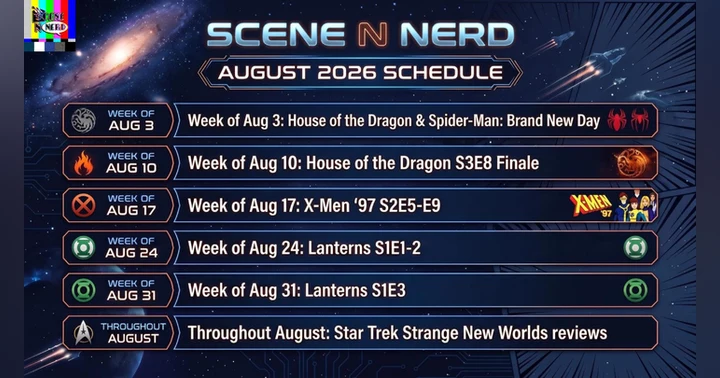
August 2026 at Scene N Nerd: Dragons, Lanterns, and the Final Frontier!


