


 Apple Podcasts Apple Podcasts
 Spotify Spotify
 YouTube YouTube
 iHeartRadio iHeartRadio
 Goodpods Goodpods
 Castbox Castbox
 Overcast Overcast
 Amazon Music Amazon Music
 Podchaser Podchaser
 RSS Feed RSS Feed
 Castro Castro
 Podcast Addict Podcast Addict
 PocketCasts PocketCasts
 Deezer Deezer
 TuneIn TuneIn
 Gaana Gaana
Key Takeaways
- White Vision wrestles with identity, fatherhood, and his inability to process emotions like the original Vision, asking deep existential questions about what makes someone real.
- Tommy's storyline explores the blurred lines of being Wanda's son versus his past life as Tommy Shepherd, highlighting themes of manufactured identity and grief-driven creation.
- The podcast opens with a heartfelt tribute to Sir Patrick Stewart and Walter Koenig, examining legacy and leadership through iconic roles like Picard and Professor X.
- The hosts break down the role of Stark AIs like Friday and Edith, debating whether artificial intelligence represents mere tools or sentient beings with valid rights and consciousness.
- Sarah and Will examine Paladin's villainous motivations and backstory, contrasting comic book trauma with the series' overarching philosophical themes.
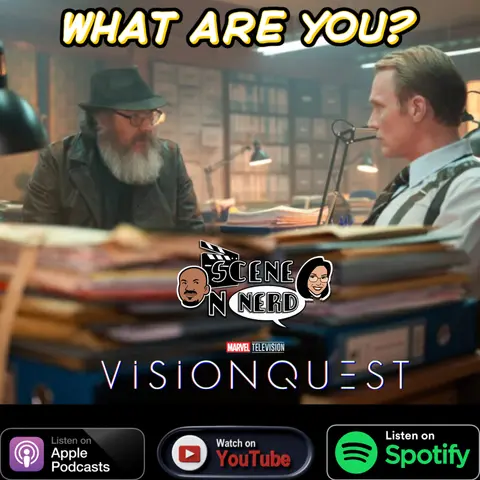
White Vision is asking what makes someone real and Tommy is living it. Our Vision Quest Episodes 3 & 4 review goes there.
Sarah Belmont and Will Polk break down Marvel's Vision Quest Episodes 3 and 4, from White Vision struggling with fatherhood to Tommy wrestling with being Wanda's son, to the AIs asking who am I. We dig into the Mind Stone reveal and why White Vision can't process emotions like before, debate Paladin as a villain, and get into Sarah's hot take on the Marvel quips overload vs Will's fun Interpol break-in moment.
We also open with a tribute to Patrick Stewart and what Picard and Professor X meant to this kind of story about identity and legacy.
Is Vision a tool, a copy, or a father? Is Tommy Shepherd or Maximoff? Drop your take below.
Timestamps
00:00 Introduction and Remembering Sir Patrick Stewart and Walter Koenig
02:36 VisionQuest Season 1, Episode 3 Review
13:20 Sentience and the History of the Stark AIs
17:27 VisionQuest Season 1, Episode 4 Review
27:36 Sarah's Thoughts on Nobody Wants This Season 3
30:13 Sign-off and Where to Find Us
SPOILER WARNING: Full spoilers for Episodes 3 and 4 of Vision Quest ahead.
Follow Scene N Nerd on X, Blue Sky, Facebook, Instagram, and Threads, and visit SceneNNerdPodcast.com.
Rate, follow, and leave a comment on Apple Podcasts, Spotify, YouTube, or wherever you listen to podcasts.
Frequently Asked Questions
What is VisionQuest Episodes 3 and 4 about?
Episodes 3 and 4 focus on White Vision struggling with fatherhood and sentience, Tommy dealing with the fallout of his identity as Wanda's son, and the deeper philosophical questions surrounding AI consciousness.
Who discusses the VisionQuest episodes on the Scene N Nerd Podcast?
The episode is hosted by Sarah Belmont and Will Polk, who break down the character arcs, themes, and Marvel lore.
Why is White Vision struggling to process emotions?
As a copy of the original Vision without the Mind Stone, White Vision lacks the emotional processing capabilities of his predecessor and is forced to confront what it means to be real.
Who are the AI characters featured in VisionQuest?
The series features Stark AIs like Friday, Edith, and Jarvis, exploring their origins, loyalties, and the point at which an artificial intelligence becomes a sentient being.
0:00 >> Sarah : Foreign. Nerds. This is seen in Nerd. I'm m. Your host Sarah Belmont and with me as always is our Mr. Producer Will Paul. How are you doing tonight, Will? >> Will: Doing very well, Sarah. Hope you're doing well this evening. >> Sarah : I'm doing fine. Happy November. >> Will: Happy November. Yes. We are here. 49 days to the solstice. >> Sarah : Yeah. Coming to an end of 2026. Can you believe it? >> Will: I know. But yeah, we are here. I was going back and forth about whether or not to start with this, but it had to. Well we lost two people in the Star Trek universe last week. Walter K. Nic and of course we also lost Patrick Stewart and he was of course John Luke Picard. And for many, many fans of Star Trek, for me I was very young. I wasn't even born when the original series came out and really I love the original series but Next Generation when it came out in 80 that was like my really my Star Trek. And, and and of course obviously Kirk was bold but Picard was like be better. And I think the lessons of leadership and things that that character portrayed, I mean it was just the embodiment of like I guess knowledge and empathy and curiosity and just, just being a better person, a better leader. So me of course he, Patrick Stewart and his portrayal of Picard did that. I'm sure like many fans of either Star Trek of course here in the Marvel universe and
1:32 they were talking about Vision Quest tonight but of course many people, their first experience with them was his portrayal of Professor X in the X Men franchise and and then of course Logan and then later we did see him in the mcu and of course we'll his final performance will be in Avengers Doom status coming out. As you mentioned, we're coming to the end of the year and that's we'll see him as Charles Xavier one last time and whenever doomsday releases on December 18th. But just wanted to recognize Patrick Stewart. Don't really have maybe not the most eloquent words but or for him but he was definitely just a true. He's been around for like my most of my life. >> Sarah : Yeah >> Will: like one of those things where I just like you just get used to that presence and I can remember of course his story stage work at the Royal Shakespeare Company. I mean he was just a true Titan. Even Excalibur which I think was one of his first like feature films that he did. So yeah, just rest in peace sir Patrick. And I think he just really he will be missed.
2:26 >> Sarah : Yeah he definitely left a mark and had a Presence. And all of those TV shows are still accessible. I mean, that's the beauty of being an actor of that caliber is that, you can still see them. So there's still a legacy. >> Will: Yeah, >> Sarah : yeah, yeah. Ah. All right. Well, that brings us into talking about the Vision and its legacy with Vision Quest. So season one, episode three, reboot Vision, and Tommy Shepard joined forces in order to survive while a terrifying killer strikes again. Will, where do you want to start? With this episode? >> Will: Yeah, yeah. So continue with the themes of Patrick Stewart and, and, and. And also Terry Matalis, who was the showrunner, for Star Trek Picard season three and also two. But in particular season three, I. One of the things I thought about last week and I didn't bring it up while we were discussing it, because I just didn't. I wanted to see how these next two episodes went, but really just thinking about how, how similarities that I saw in that show in Picard, I'm, seeing it here a little bit with. Where there is the father son dynamic, these characters. And whereas in Picard you had the emotionally distant Picard finding a son who he knew that was his biological son, but taking it to Vision, here we have Vision, who is emotionally distant but also trying to figure it out. Like OG Vision, he's based off of conjured by
3:57 Wanda in Westview. So he's trying to, like, also find that sense of belonging and learn how to be a father to Tatami. Was trying to answer the question as far as, like, who does he belong to? And all as far as where does Tommy come from? So there's that whole exploration of those father son relationships and dynamics with these two characters. He's always really struck by that. >> Sarah : Yeah. So in terms of the father son dynamic that you brought up, I think that it has more to do with identity. >> Will: Yeah, >> Sarah : yeah. Because being a father is an identity. >> Will: Yeah. >> Sarah : Right. Just like for you, you're a father. That's one of your many identities. But you're also a lawyer. >> Will: Yep. >> Sarah : And then you're you, and then you're you with.
4:38 Inside your marriage. And then like, like as a couple. Like, so, like, there's multiple identities there. And with Vision and Tommy, both of them are dealing with this thing where they are, for lack of a better words, copies. Vision, the vision in this series. To clarify, White Vision is a copy of the vision we lost from in Infinity War. Right, >> Will: right. >> Sarah : So then you also have Tommy, who. And we know this from Agatha Long, like, died in that swimming pool, but got. Instead of going into the afterlife, he. He got Kind of mind adopted and was like, no, you gotta still be around because you now carry this presence of this other person, and their identity. So now like you're the Tommy before and the Tommy now. So there's, there's a mix. So I think that this episode I liked and like, I say that loosely and I especially like the line, you are what you think you are, because that's what we're dealing with. Like, and I think it's such an interesting point mainly to go back to previous discussions we've had about the villain.
6:02 >> Sarah : And how a good villain, they think they're right because they're the hero. And any person in their life believes that they are the hero, they're not the bad person. And any action that they do. So, so identity and the questioning of it is really interesting and I just like the way that they put it in terms of you are what you think you are. Because think is such a good word to put in all of this. At the end of the day, Wanda, well, she more than just thought. >> Will: Yeah, >> Sarah : she conjured it that she made happen. And another thing that was pointed out by the Midnight Boys over on the Ringer podcast that I thought was an excellent point, is that what they have not explicitly said, and I hope that they don't, because I think it's a really strong point, is that Wanda did essentially create life.
6:57 >> Will: She >> Sarah : did. So now she did not do that the quote unquote natural way. >> Will: Right. >> Sarah : Creation, Marvel way. Okay. What we're also learning in these two episodes and figuring out and the whole point, one of the many points of this series is also that the whole AI creation is just evolution and it's the creation of a more advanced life form, so to speak. So now humanity of it all don't really know. But so in a nutshell, that was like my big takeaway from this episode in particular and it kind of led into the next episode. But >> Will: yeah, yeah, I'm glad you brought that point up with, with Wanda basically creating life. And it was out of her grief that she did create the whole family she wanted. And you mentioned about like identity and one of the things that the things that parents will impart upon their children, their identity and things that parents like sometimes will get carried down to their offspring. Like for example, Tommy having the same affinity for old television shows that Wanda had.
8:11 Those touches that I picked up in the episode where it just reinforced that this kid Tommy, Wanda took conjured visions child, and particularly Wanda because of just some of the things that she Liked and. And then convinced Tommy that. That he is real, that Tommy Maximoff is real. He's not. Not some fantasy. And. And so I like when you mentioned. You brought up the line about you are who you think you are. I mean, I think that was a really important point that they shared and to that point to the AIs. >> Sarah : well, before we go there. >> Will: Yeah, yeah. >> Sarah : And leave this, I just want to bring up. I would've liked to understand more if he had the affinity for TV shows before the swimming pool. Because that's where I'm missing. >> Will: Yeah.
8:52 >> Sarah : Like to me, that whole point I was like, okay. But my mind immediately went, is he talking as if like he had an affinity for them before all of this or. Because there ah, are at times Tommy seems to be like everything changed in that pool. >> Will: Yeah. >> Sarah : There's some awareness of the life and the identity he had before, but now he's like something happened. I can't explain it, I don't understand it. And so it's making me go a little crazy. Well, of course it's trippy because the other thing, what I thought was more interesting was more about this, what they did. And it was very clever of the. I read about you guys.
9:42 >> Sarah : Like years ago. >> Will: Yeah. >> Sarah : And. And that bleeds into this whole other thing. Parasocial relationships. Like. >> Will: Yeah. >> Sarah : Which is more prevalent now than ever before given our media and our social networking and everything and access to especially public figures like the Avengers are in this world. Public figures. >> Will: Yeah. >> Sarah : Their stories are accessible and if you read up enough on them, you suddenly could plant in your own subconscious like you know, who they are, all these things about them. And. And in a way that's exactly what white vision re watching those scenes from what happened during WandaVision.
10:28 >> Will: Yeah. >> Sarah : I guess overall point is that I just want to understand more that awareness of like who he was before versus who he is now. >> Will: Yeah, yeah. That's a. Yeah. I mean because I think that definitely that's a very good point. And it gets to. Again to his. What is. What is his identity? And well, >> Sarah : it gets to that point of what's real. >> Will: And >> Sarah : you're dealing with a synthetic person. >> Will: Yeah. >> Sarah : And you're dealing with memories conjured up by a witch. And you're dealing like. And you're also like I was drowning. >> Will: Yeah, yeah, yeah. So yeah. So I was drowning. Where does the Tommy shepherd and the Tommy. Tommy Maximoff like begins and ends and.
11:10 >> Sarah : Right. >> Will: Yeah. And so. Yeah. Because I mean he was talking about that he's speaking as Tommy Maximoff or was he talking about memories he had from Tommy shepherd as far as that parasocial relationship he had with as the Avengers? >> Sarah : Yeah. And. And that's why Vision twisted it, because in that very calculated way, he's just like, okay, I can use this to kind of convince you that's a different person. And it comes full circle because by the end of it, he's like, no, it's not a fantasy. This is reality. You're experiencing this and going through this. Tommy Maximus is as real as Tommy Shepherd. So, like. And he's dealing with it too. So. But all of the simulations that he did and everything I thought was good. Then the other thing about identity that they bring up is Paladin.
12:00 >> Will: Yeah, I was about. Yeah, >> Sarah : yeah. Because we learn that he is not, by blood, a Paladin. >> Will: Right. >> Sarah : And his father was a hit on Paladin's list. And when he was taken out, then he became adopted. So. So classic comic books. >> Will: Yeah, yeah, yeah, yeah. Got three levels of trauma here. Now we've got visions. Trauma, as far as, like, the white vision, trying to not only his current predicament where he's, like, wounded, but then also just the trauma of just that he is trying to work through repeating the mistakes of running these scenarios. And each one is just like each time, Tommy storms out of the room. So Tommy's got his things that we just talked about, and now we got the Paladin and the Butcherbird, doing the mind meld and, like, extracts the his backstory. And then also it drives why he's just so determined to complete this contract, because that's just so much part of his identity. And whoever mysterious person who's hired him says, you failed. And he's like, he keeps assisting him.
13:01 Give me more chances. >> Sarah : Yeah, >> Will: yeah, yeah. I mean, as far as the Paladin, still, to your point about a good villain, he still seems a bit under baked for me. I will say. I mean, I know they were really trying to, like, drive some stuff home as far as backstory and stuff this episode, but I will say that whenever they went into that part of the story, it did not resonate with me as much as the Tommy story and Vision story or even the stuff that was going on with the AIs. >> Sarah : yeah. What was going on with the AIs? >> Will: Well, I think it's getting into. Of course, Friday talks about the day of the snap, when Tony dies, and that how she was there at that moment. And so I think they were really between Friday's story and then, of course, Edith really exploring learning the backstories of the people that they were all based off of. And of course, they lost Jarvis in the second episode whenever he sacrificed himself whole keep the whole system running. He got into. Into this place where. At what point is the artificial intelligence a tool or just a machine versus sentient being that has consciousness? That's deserved that. That should be. Treat it like a person who has rights and all.
14:12 versus, like I said, versus versatility to be used. >> Sarah : I've never really thought about this before, but in this universe, how do they differentiate the snaps? Because there's the snap and then there's the snap where Tony died. Because, like, when you're like, the day the snap, my mind went to Thanos's. >> Will: That is a snap. Yeah, it was like the reverse snap. Yeah. The second >> Sarah : snap. Yeah. So I'm. Okay. So I wonder if they're like one versus snap number two. >> Will: Yeah. It's like Tommy's shirt. Yeah. What did the shirt say? Oh, gosh, I can't remember what it was, but he had the whole snapshot. He was trying to get to vision there when they were at the hotel. But. Yeah, that's a good point. No, >> Sarah : I just never, Never thought about it until you brought up the snap. And I was thinking about one and you were talking about the other.
14:56 >> Will: Yeah. >> Sarah : Like, >> Will: there's >> Sarah : a lot of snaps. >> Will: Yeah. Tony Snap. Yeah, Tony >> Sarah : Snap. Tony Snap. I also don't know. Don't completely agree to what you're saying about the function, what they were getting at here. Because to me, the. What they were getting at between these two episodes. Is this another thing I've never quite realized or has been brought to the forefront that these AIs have been around for. There's like, the Avengers and then there's the AI Avengers. There's like the subunit. Okay. And these are bonded. It's almost like a. And you know, this feeling a, dog and its owner. Right.
15:41 Like, there's a bond there. And then what they also get into is the fact that these. These AIs are all based on people. Yeah. And I, was almost gonna say it's like similar to Wanda's conjuring of Tommy and Billy, but they were not based on necessarily people. She just conjured them up. They became who they were. So. But these people, they're more similar to ghosts because they are. They at one point were real people who. And now they're just reminders, almost like. And a copy, as we've talked about before, of what's going on with White Vision. And Tommy. So.
16:24 >> Will: Yeah, >> Sarah : so >> Will: but even though based off of people there. But. But again, their experiences are different because like, for example, Edith marks that where at least is based off of that in the plane crash. >> Sarah : Oh, yeah, of course experiences are going to be different because like, there was the life that the human lived. >> Will: Yeah. >> Sarah : And then there's, however you want to put it, that the AI based on that human, like they may have the memories of that person or they may not. Because it seemed like Edith did not have the memories of who she was based off of. She had to discover that and learn about it. So upon learning about it, then I think that's where the AIs themselves start questioning what they are or who they are. That's what's going on with Vision. So >> Will: yeah, I mean, it does. Again, there's existential questions like, who am? I. I think therefore I am.
17:19 I mean, it's just like going back to the whole thing that, that Ultron was like saying in the first couple episodes. It's like, is this a first year college class philosophical discussion that we're embarking on and watching this show? >> Sarah : All right, so that brings us to episode four, Malware. As Vision confronts a new enemy, Ultran and Tommy shepherd come face to face. I just like how they keep using Tommy Shepard. Tommy Shepard, >> Will: just in case. Yeah, no spoilers there. No spoilers there for anybody. >> Sarah : So funny. >> Will: Yeah, >> Sarah : so funny. No, I don't think that's why they're doing that. I think they're doing it because they don't want to confuse it. >> Will: True. >> Sarah : So, yeah. So where do you want to start with this episode?
18:02 >> Will: Well, I guess we can just pick up where it starts. Where? Of course, at the end of the third episode, whenever Vision shuts down and restarts, she infiltrates a system. And of course Edith has to do the whole exorcism to like get in and out. But yeah, we definitely learned more about sort of backstory and origins of just a starkiece and how it was a company that basically develop all the source code. And of course Tony acquired them after. Whenever he was building up Stark Industries and stuff. But I guess we really start getting to the meat of what the show's about, which is of course the, the Butcher Bird is killing. Killing all the, scientists who were behind these. These codes for, for their bio keys.
18:43 For some reason that we still have not gotten fully >> Sarah : to go off of what you just said about like that reference you made to, to something that Ultron said. Like, okay, so this is my problem. This episode I got taken out of. I totally checked out. Mainly because of all the freaking puns that were just then. As soon as I started hearing them, I remembered like. I think it was this kind of writing that also occurred in the first episode that put a very sour taste in my mouth. I just. It was a lot. And I also. I think why I liked the previous episode was because there was not as much all of the AIs together in a room. And in this episode there was a lot more of that and there was like. It became a whole murder mystery pun. And I was just like, oh God, >> Will: I >> Sarah : don't know. It just rubs me the wrong way. And it makes it feel like to your point, you go from a very philosophical discussion, high thinking to what feels like after school television. And I'm not saying that as a reference to WandaVision or anything. I'm saying that more as like a dumbed down version of like a something else. It just. It doesn't work for me.
20:03 >> Will: M. So, I mean, I actually really did like the whole whenever Ultron and Vision had to break the Interpol system. And I thought that was just fun to me. I thought that was a fun bit where. Where they were having to do all the authentications and coming up passwords and the whole HUD of it all. >> Sarah : I honestly don't even remember that part of the episode. >> Will: Oh, that was one of the best parts of the show. I >> Sarah : don't remember >> Will: because I mean, to me, like when they had the. We finally got our fights, but. But with the. With vision and daCosta. I mean, excuse me, but I thought that was just a really fun bit. Fun little bit to it. But I guess the other thing too, though, getting more back to some of the more philosophical things and something we talked about last week was just. We did get the reference to.
20:44 With respect to the murder mystery aspect of it all, we get the. The first synthetic one. The first of us, Jim the Human Torch. And I know we get a little bit more backstory as far as what happened to him there, where his inability to process complex emotions led to him literally flaming around >> Sarah : from the inside out. >> Will: Yeah. I guess tying into Marvel. The Marvel lore, of course, of it all, we learned that the. I guess the Mind Stone is the thing that was one of the reasons why Vision was able to manage is the emotions because of the, you know, he. We had the Essex machina, of the. Of the Mind Stone helping to do that. >> Sarah : Well, the process of it, >> Will: yeah, >> Sarah : it's not so much managing. It's like processing complex Emotions and complex things. That's an interesting. Yeah, yeah, you're right. Like, that was a standout moment, if not the standout moment in this episode, when they. Because I appreciated how you gave me those brief Cliff Notes last week, so I understood what they were talking about.
21:42 Okay, >> Will: I'm good for something. >> Sarah : So I. No, no, you're good for a lot. But it just made this whole thing more stand out. >> Will: Yeah. >> Sarah : And also kind of raised some stakes with what's happening with white vision because it allows for clarity of distinguishing what was so. So powerful and complete about the vision that we lost versus this copy that we have right now. Who, I mean, is not the same, neither power wise, strength wise, or just obviously processing emotion. I mean, he barely knows how to talk to his son, so he. So, yeah. But, I agree. And just that whole, like, it's weird because on one hand I'm like, I cannot stand all of the AIs in a room. But when we're like, just talking Tommy and Vision standing and them learning about the history of eyes and. And getting that whole. I'm fine with it. Like, I'm more fine with it when it's not all of them at, once. Mainly because I don't know why the writers keep doing this. There's so many freaking puns.
22:55 I'm like, dear Lord, let it go, guys. And I may be the only one who hears it, but yeah, if we go a full scene and I just hear pun after pun after pun, I'm like, checked out. >> Will: Yeah. I have to say, to me, this timer, I completely agree with the Marvel quips because that's. That's one of the MCU is definitely known for that. But like I said, I felt that this episode, for me, it actually worked the humor whenever they were breaking into interval. But. But speaking of the of it all, we do learn that it is the butcher bird and it was the Dr. Carrington. We definitely learned that she did not. And we do get the, you know, image of her of, you know, the. Is she getting to this theme that we've talked about with identity and stuff? I mean, it seems that this is just a question that I have. I don't have an answer at this point. But if she. Whenever the natural person passed away, does she imprint her memories or whatever into this AI or what's going on there? But we definitely. And like I said, part of this is just sort of getting the bio keys of all the other scientists who help to write the codes and stuff. I guess as the series progresses, we'll learn more about what is the ultimate thing that she's after here. But there was a lot of, like, references to it. And his. He was voice of Ultron, was trying to relate to Edith. Like, for example, whenever they did have the conversations about the AIs being Ultron, of course was like, well, I was just conjured up in a lab, bad things coming. But, >> Sarah : well, he was distinguishing himself from the
24:26 others. >> Will: Yeah, yeah. >> Sarah : Like, it's kind of like I can understand only so much because I am somewhat like you, but we are not the same. >> Will: Yeah, >> Sarah : that's what he was saying. Like, I, am sympathetic, but I. We are still different. So I can't be empathetic. Maybe. >> Will: Yeah, yeah, yeah, yeah. There's that. and then this whole AI, this discussions and stuff in this conference that, what was named Katrina Wells. She was having this. This gala on the anniversary of the whole Sokovia, incident. And comes into question in the species. Like, you know, we can create things that these AIs can become really great, like, like Vision or they could go really sideways, like Ultron. So I have to say, I mean, given how generative AI and just it's such a big topic of discussion and his current discourse. And as I'm watching this show, trying to glean like, what they're trying to articulate here. Viewer, >> Sarah : what have you gleaned so far?
25:22 >> Will: A couple things. Well, maybe I think they're like really asking us as viewers. On the one hand, it was like the glib response would be like, are they trying to like, normalize, you know, this technology or. But another thought I had was too, was like, well, I mean it. But it is really a tool. But I guess if you do carry it to as crazy extremes where everybody does one. One of the jokes around my office sometimes it's like when we talk about coming up, apologies and stuff. It's like, does anyone watch the Terminator? So it's that extreme as well. And I think they also have two extremes here. We have the Vision, where he's like, uses these abilities for good, whereas we have Ultron, who does it for bad. And we saw that in this episode where he basically, like, it seemed like he was trying to be Mr. Good Guy and be like Mr. Grandfather and. And all that. But ultimately he was manipulating it to his own end, get control of Vision's body. And then once he did get control, he was predictably. He locked them all out.
26:15 >> Sarah : Yeah, Yeah. I mean, that's the thing that's annoying about Ultron is it's so predictable. So, like, not for one second did I think, like, he was trying to be a good guy. He's just trying to work an angle. >> Will: Yeah, >> Sarah : yeah. But then again, the question is, well, why does he want to get out? >> Will: Yeah. >> Sarah : Like, what does he want to do? Does he try to execute the plan he tried to do in Age of Ultron? >> Will: Possibly. Yeah. I mean, he did bring up peace in our time again, so. >> Sarah : Yeah. Yeah, >> Will: yeah. >> Sarah : So, anything else about this episode, show as a whole >> Will: as far as this episode? I mean, I like the fact we're getting progress, we're moving ahead. I will say I was more engaged with these two episodes. I like the first two, don't get me wrong, but I like the path that they're going on. Definitely very engaged with it. I think they are, I think, storytelling wise, doing some pretty good stuff here. And, Yeah. So I'm just looking forward to watching the next two discussing it with you.
27:07 >> Sarah : Yes. Yes. Yeah. Like I said before, I liked episode three so far is the best out of all the episodes for me. And we'll see. There's something about it. I don't know if it's. Maybe I'm pulling the will card and I'm burnt out on Marvel. There's definitely a disconnect. And I'm not, like, eager to watch these episodes either. But we'll see. We're going to finish it one way or the other. I, mean where to start it, so whatever. I will let you all know. In case you were wondering, I did watch season three of Nobody Wants this, and that came out on Netflix like, two weeks ago. I binged it, like, the first weekend. And here's my thoughts on season three of Nobody Wants this.
27:51 Season three is actually very similar to season one, and I say that because of the ending. They basically, season two and season one compliment each other and, like, close a chapter. And there's a lot of loose ends that they close up with season two, even though it's eerily similar to this season one finale. But in season three, they, like, don't go backwards, they actually go forwards, but they have. What was so jarring, I think, for a lot of fans of the show, is the season three finale. You have so many loose ends and you're just like, wait, wait, we have to wait another year to what? And it felt very similar to season one, where it's like, we're just getting started and, we're on the crux of it. So I kind of like that because I'd rather be wanting More than being like, okay, so that was that. But, yeah, I enjoyed it. Surprisingly, I have not, like, lapped it at all. I've only rewatched maybe one episode.
28:57 And yes, it was the watch what happens episode. And we all know why, if you're a fan of the show, why I rewatched that episode because, I'm definitely. There's a certain ship that I'm on. And maybe that's why I'm having such issues with the. As you put it, the Marvel quips, because I've never had an issue with Marvel teamwork before. but maybe it's because I watched Nobody wants this season three. And immediately within the, like, first few episodes, what stood out the most to me was the brilliant humor there. Like, I missed it. There are so many times I was watching it while eating breakfast or dinner, and I would, like, almost choke on my food. So there was just some really smart writing that I have not seen in a hot minute. And it reminded me of why I love that show so much because I subscribe to that humor and I am fully subscribed to the ensemble cast that they have for that show. Yeah. So just wanted to give everybody an update on that.
29:56 >> Will: Yeah, no, I'm glad. Thanks for that update. I totally get what you mean. I think sometimes, definitely go. We go in seasons with these things and not necessarily tell. I mean, just sometimes things just hit for you and sometimes it doesn't. And a lot of times it could just be like you said, when you compare and contrast what something else you're watching. Yeah. Things may pale in comparison. >> Sarah : Yeah. All right, well, on, that note, why didn't tell our listeners where they can find you? >> Will: Yes, you can find me on all the socials. W I L L M P O L K. >> Sarah : You can find me there, too. SJ Belmont sjblmon t. Please follow our crew on X formerly known as Twitter at cena Nerd. on Blue Sky. Friend us on Facebook, follow on Instagram and threads Scene ncore nerd and Visit our website, www.scenerdpodcast.com. but most importantly, rate, follow and comment on Apple Podcast, Spotify, YouTube or wherever your podcast. Good night. Geek out. You're welcome. Sam m.